


Major contractors operating inside the Defense Industrial Base play a vital role in designing and producing the aircraft, spacecraft, missiles, and advanced systems that protect the United States and its allies. One of the largest enterprises in this ecosystem employs roughly 123,000 people and generates more than $75 billion in annual revenue. With a history stretching back over a century, these organizations have built deep expertise across aeronautics, missiles and fire control, rotary and mission systems, and space capabilities through continuous research and development.
In addition to their physical systems, these contractors maintain sophisticated cyber capabilities. Many rely on structured frameworks such as the Cyber Kill Chain, a seven-step process that helps security teams visualize and understand how adversaries operate in cyberspace. This model breaks down attacker tactics, techniques, and procedures so defenders can interrupt campaigns at multiple stages.
Persistent nation-state threats
Contractors across the Defense Industrial Base face constant pressure from Advanced Persistent Threats, including nation-state actors seeking to steal sensitive intellectual property or disrupt critical programs. In recent global conflicts, there have been documented claims of cyber operations targeting U.S. defense contractors and similar high-value targets. These adversaries are well-resourced and patient, often focusing on long-term access to the most sensitive data.
These organizations hold vast amounts of classified and controlled information used for manufacturing, maintenance, research, and intelligence, they represent high-value targets. Protecting that information while keeping complex global supply chains running requires a layered, continuously evolving security posture.
Core threat vectors and security foundations
The primary risks center on the theft of intellectual property and the compromise of the supply chain. Even with strong perimeter controls, the value of the data held inside these environments makes them attractive targets for espionage and tampering.
To address these risks, leading contractors have adopted zero-trust network architectures combined with continuous monitoring aligned to the Cyber Kill Chain. This approach extends across both traditional enterprise networks and critical operational technology environments, including Industrial Control Systems and Supervisory Control and Data Acquisition platforms that manage physical manufacturing processes.
These protections are reinforced by compliance with the Cybersecurity Maturity Model Certification (CMMC 2.0) and the requirements outlined in NIST Special Publication 800-171 for protecting Controlled Unclassified Information. You can review the official CMMC guidance here: What is CMMC 2.0? A guide to CMMC compliance requirements for defense contractors. The NIST framework for safeguarding CUI in nonfederal systems is available here: Protecting Controlled Unclassified Information in Nonfederal Systems and Organizations (NIST SP 800-171 Rev. 3). Strong access controls, regular training, configuration management, and well-prepared incident response teams are all integrated into daily operations to maintain resilience around the clock.
Risk assessment across the Defense Industrial Base (DIB)
Contractors regularly evaluate risks using structured matrices that consider both the potential impact and the likelihood of different threat categories. Here is a representative risk matrix used in the sector:
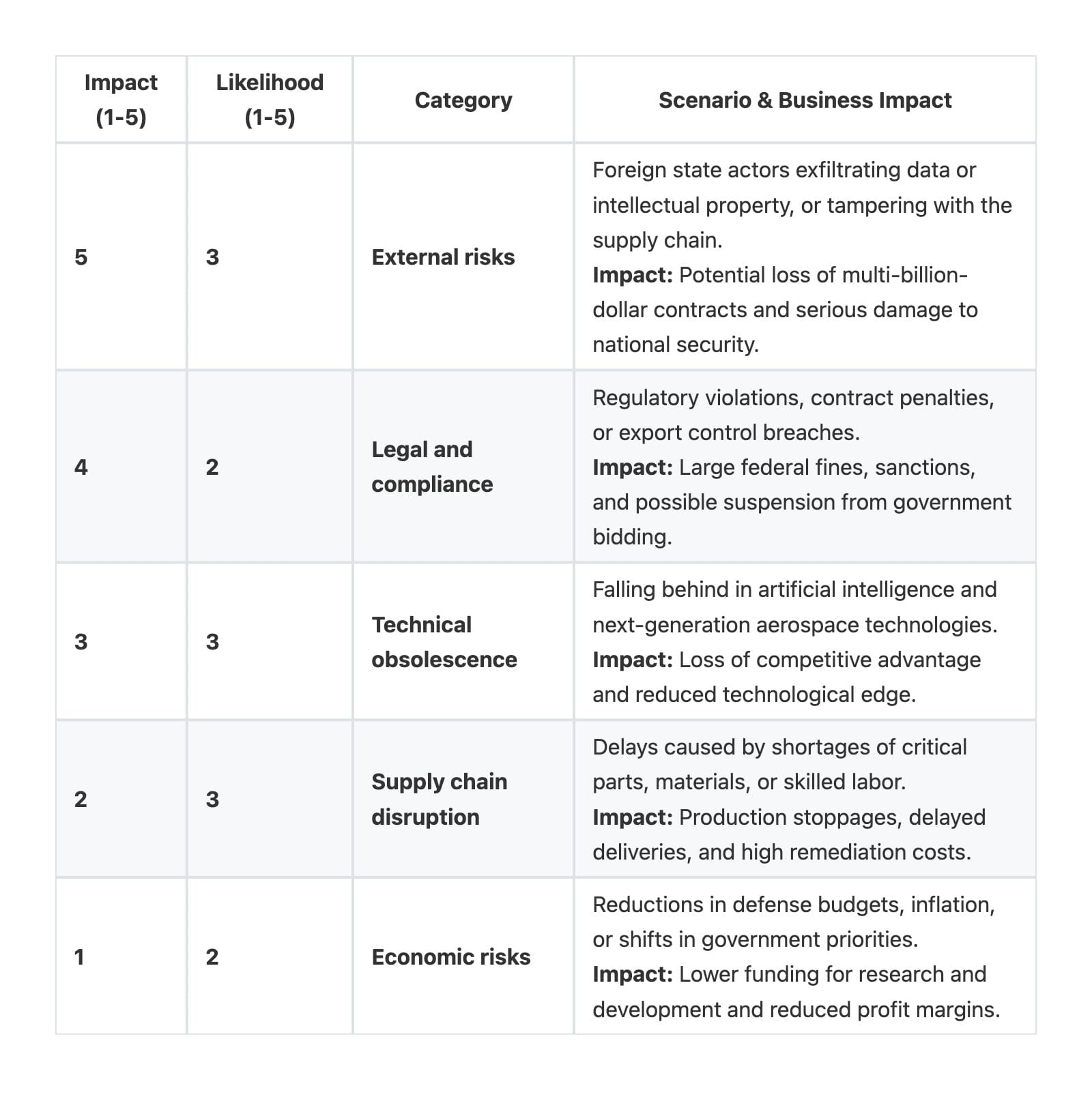
Global supply chain complexity and increasing reliance on third-party vendors also create “system of systems” vulnerabilities that can introduce single points of failure. These pressures require ongoing threat modeling in both physical and digital environments, supported by mature incident response capabilities and centralized security monitoring platforms.
Building advanced threat intelligence capability
Leading contractors have developed sophisticated internal platforms to collect, validate, and act on threat intelligence in near real time. The goal is to detect stealthy nation-state campaigns before they can exfiltrate sensitive military intellectual property or interfere with manufacturing lines.
Data collection draws from multiple streams, including threat intelligence databases, signals intelligence, vulnerability assessments, and open-source information. Special attention is given to monitoring access attempts from high-risk geographic regions, enforcing strict conditional access policies, and requiring multi-factor authentication for sensitive actions. On the manufacturing floor, network flows from Industrial Control Systems and SCADA environments are continuously ingested to establish normal baselines and flag anomalies that could indicate tampering.
External indicators are cross-referenced against reputation lists, Software Bill of Materials data, and dark web monitoring for leaked credentials. To avoid tipping off adversaries, strict operational security rules are enforced, no active probing of suspected malicious infrastructure from corporate networks, and all malware analysis is performed in isolated, air-gapped forensic environments.
Data ingestion architectural strategy
Modern platforms combine high-speed streaming with powerful analytics. Telemetry from endpoints, network devices, identity providers, and manufacturing systems is collected using OpenTelemetry collectors and custom connectors written in Rust for performance and reliability. This data flows through event brokers such as Redpanda before reaching analytics databases. A representative pipeline looks like this:
Data Sources (Host EDR telemetry, network firewalls, SCADA/ICS lines, air-gapped SCIF environments)
→ Streaming & Brokerage (OpenTelemetry daemons routing through Redpanda via Rust hardware adapters)
→ Analytics Tier (ClickHouse OLAP database performing real-time threat matching against STIX/TAXII indicators)
→ Lakehouse Archival (Delta Lake on immutable cloud storage for long-term compliance and forensic review)
High-velocity data stays in the hot analytics layer for immediate investigation. After approximately 30 days, it is compressed, encrypted, and moved to a schema-enforced Delta Lake environment that meets multi-year federal retention requirements while remaining queryable for analysts.
All incoming telemetry is normalized into a consistent schema — standardizing timestamps, removing duplicates, and mapping fields to a common data dictionary. This allows security teams to quickly correlate, for example, a suspicious IP seen on a perimeter firewall with unusual authentication behavior or anomalies on a production SCADA pipeline.
Validation, analysis, and prioritization
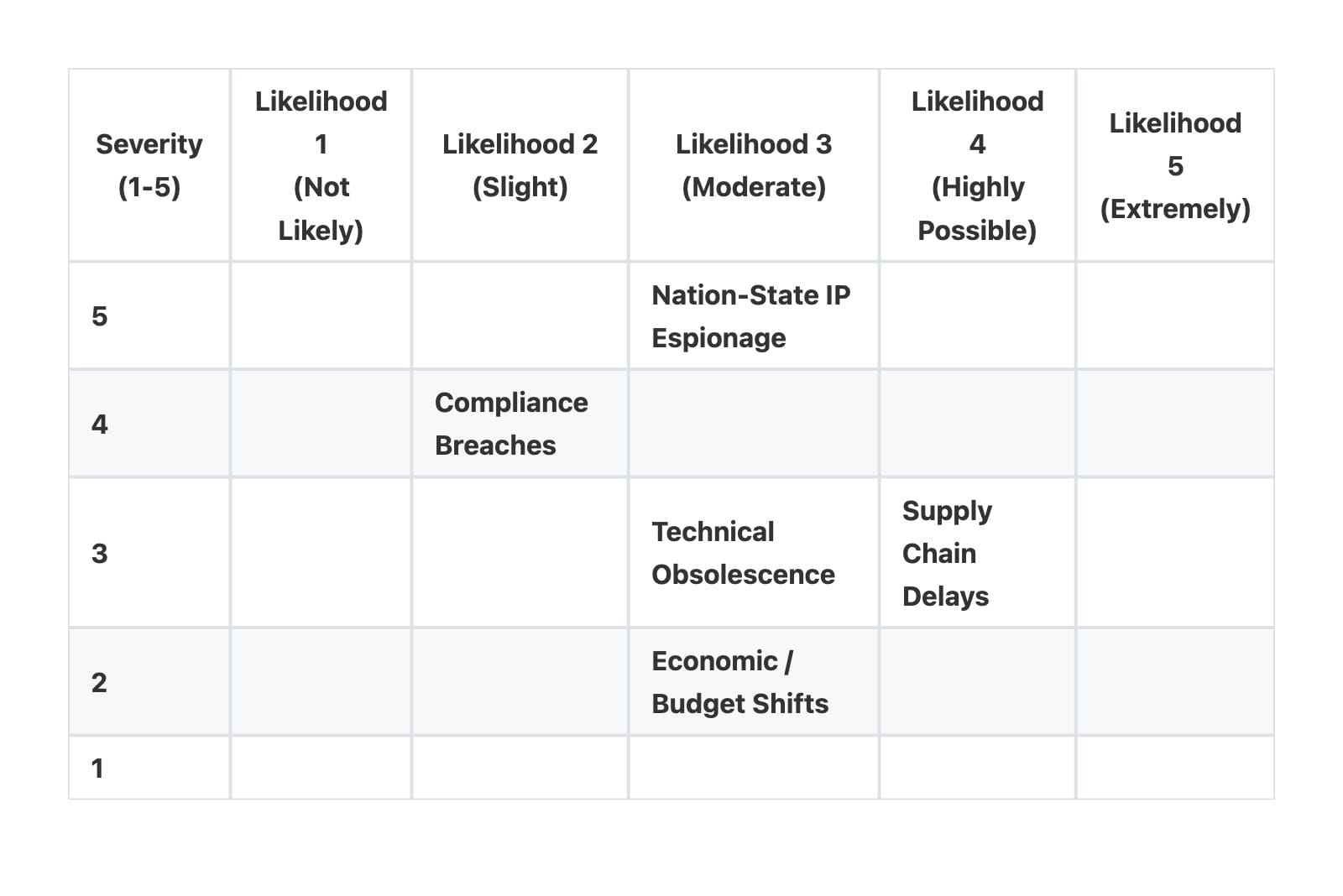
To prevent alert fatigue, ingested indicators are automatically validated against internal knowledge bases and partner repositories before reaching human analysts. Validated threats are then mapped to the MITRE ATT&CK Framework and the Cyber Kill Chain so teams can understand exactly where an adversary sits in the attack lifecycle. A threat prioritization matrix helps focus defensive resources on the most dangerous activity:
Operational testing and findings
Through a dry-run perspective, imagine one major contractor ran a comprehensive evaluation across regional analytics nodes, streaming brokers, OpenTelemetry collectors, and twelve distinct Industrial Control System and SCADA gateways. The testing covered two phases totaling 360 continuous hours and examined strategic, tactical, and operational threat intelligence.
During the evaluation window, the platform detected active scanning campaigns targeting external sensors and VPN gateways. Adversaries attempted to map and reach Programmable Logic Controllers on manufacturing subnets, resulting in a roughly 300% increase in suspicious inbound traffic directed at ICS/SCADA environments. Some attempts involved trying to deposit malicious binaries onto honeypots in an effort to gain persistence inside production control systems.
Direct impacts of a successful compromise could include theft of proprietary aerospace designs and potential physical damage to manufacturing equipment.
Indirect impacts could involve significant incident response costs, regulatory penalties under CMMC 2.0, and loss of trust across the broader Defense Industrial Base.
Secure intelligence sharing
All findings are classified using the Traffic Light Protocol (TLP 2.0) to control distribution safely. You can review the official definitions here: Traffic Light Protocol (TLP) Definitions and Usage | CISA.
- TLP:RED — Strictly limited to named individuals on the local incident response team.
- TLP:AMBER+STRICT — Shared internally with CIRT members and executive security leadership on a strict need-to-know basis.
- TLP:AMBER — Distributed to internal security staff and trusted DIB partners who need the information to protect their own infrastructure.
- TLP:GREEN — Shared across the broader defense community and partner companies.
- TLP:CLEAR — Cleared for public release.
High-priority indicators are automatically packaged into STIX/TAXII format and pushed via web sockets to SIEM and SOAR platforms for immediate blocking. Strategic intelligence is routed through secure dashboards for human review using a standardized 1–5 risk rating scale.
Security operations center structure
Running a high-volume threat intelligence program at this scale typically requires a dedicated Security Operations Center. A recommended model includes approximately eight full-time employees, often supported by a managed extended detection and response partner:
- Two Cyber Threat Intelligence Analysts focused on APT tracking, STIX/TAXII taxonomies, and MITRE ATT&CK mapping.
- Two Data and Systems Engineers experienced with Rust, Redpanda, and ClickHouse clusters.
- Two Industrial Security Engineers specializing in operational technology, SCADA/ICS protocols, and manufacturing baseline monitoring.
- Two Incident Response Managers responsible for rapid isolation, forensic analysis, and air-gapped malware examination.
Risk management framework
The overall risk management approach follows the structure outlined in NIST SP 800-30 for conducting risk assessments, nested within the broader guidance of NIST SP 800-39. This aligns directly with federal defense requirements such as DFARS 252.204-7012. You can review the core risk assessment guide here: Guide for Conducting Risk Assessments (NIST SP 800-30 Rev. 1). Based on observed threat behaviors, three key technical mitigations are strongly recommended:
- Micro-segmentation and SCADA Isolation: Enforce complete logical separation between corporate enterprise networks and operational technology/manufacturing environments using strict bidirectional firewall access control lists.
- Hardware-Backed Multifactor Authentication with Just-in-Time Approvals: Deploy phishing-resistant hardware cryptographic keys for all administrative access and require explicit secondary approvals for any configuration changes or destructive actions.
- Automated Perimeter Isolation Playbooks: Configure SOAR automation to instantly block external IP addresses flagged by real-time analytics for anomalous scanning behavior, moving response from manual to machine speed.
Continuing the security posture
Contractors throughout the Defense Industrial Base operate in one of the most contested cyber environments in the world. Through combining mature frameworks such as the Cyber Kill Chain and MITRE ATT&CK, robust data collection and analytics pipelines, zero-trust principles, strong regulatory alignment, and automated response capabilities, leading organizations continue to strengthen their defenses against sophisticated nation-state threats.
The approach described here — blending advanced telemetry, disciplined operational security, prioritized intelligence sharing, and targeted technical controls — provides a practical model for protecting the critical technologies and manufacturing capacity that underpin national security.
Engineering resilience, security, and future-ready software architecture. Follow on X, GitHub, and LinkedIn, and visit https://joealongi.dev/.